
I initially pursued a writing project for my Cultural Organizer portfolio in hopes to convince people of something I thought I already knew. Of Nature’s queerness, of the harmful patterns of discard society exhibits, of the power of writing things as an act of loving the world. I am not interested in convincing anyone of anything anymore, I don’t know the world well enough yet (maybe none of us ever do). I want to share what I know about life; i.e., what I’ve experienced of it; because it is the only way I know how to love a thing fully.
The first chapter of this work was going to be called “Nature is So Gay” and I was going to tell readers that Queer Ecology is defined as “a form of cultural, political, and social analysis centrally focused on interrogating the relations between the social organization of sexuality and ecology, akin to environmental justice scholarship on race and ecofeminist thinking about gender.” I was going to give all these examples of queer organisms—bisexual bonobos, fungi with almost infinite sexes, etc. That stuff is all really interesting and cool, and I would implore you to look into it if you’re intrigued, but it’s not what I know of the world. I’ve never seen these creatures (unfortunately) and frankly even if they weren’t queer it wouldn’t be enough to convince me queerness isn’t part of the nature of the world. I am a natural being. I am a creature in a body just as much as they are.
I knew this was the wrong thing to be writing as I wrote it. It wasn’t truly exciting to me. So I ask myself now: why is Nature queer? And why does it only feel right to me to explain it as such?
1. The People
In my sophomore year of college I joined an environmental club called Epsilon Eta and found myself building friendships with the most tender, loving, and incredibly queer people I’d ever met. This group quickly became my family. Not only did we share similar passion for the protection and appreciation of the natural world, these people were also some of the first to know I was non-binary–and even though they hardly knew me at the time, they embraced me so gracefully and never stopped celebrating me in all the three years I was in the group, even as old members went and new members came. Between stewardship and activism jobs my friends never ceased their solidarity for, pretty much, every social justice cause in the world. I watched, in the moments when the state of the world and this country were particularly scary (as they often are), this love for the world and its people become weaponized against my friends, become something that was uncommon as we watched the country move backwards. I also watched as their own identities became weaponized against them. I received texts from my best friend, a latina woman, from her position in Minneapolis in the midst of seemingly unending ICE raids, scared for her life. I embraced my queer friends as the Supreme Court was urged to overturn Obergefell v. Hodges. Less dangerous, but still devestating, I watched my graduating friends these past two years losing all hope in a career dedicated to conservaton as jobs were cancelled over and over again as they tried to apply to them. And it wasn’t just the fear of not getting a job, as scary as that is in this economy, but it was the dread of watching the world get mistreated, and feeling that maybe there really is nothing we’d be able to do to help it.
And yet, my queer, nature-loving friends were never truly broken down. We were all exhausted and out of hope but we went to school and work during the day and we held each other, danced together, organized together, cried together, and kept pushing on in each other’s presence at night. In the days of my worst dread at the human world and my place in it, I am convinced that community—and my place in it—was what gave me the strength to go on. We pour our queer love into the world and into each other; and if that gives even one person a reason to keep pushing, how do we know that the world doesn’t feel that too?
2. The Creatures
I think the world and its creatures do feel the love and attention we pour into it. If you let it, if you make sure to remember you are part of nature and not outside of it, the world interacts with you often and in beautiful ways. It is a queer way of thinking; that is, outside of the preconceived social norms; to think of yourself as part of nature. It is a way of thinking I’ve more often witnessed in queer people and other minority groups than anyone else. (I have not met everyone in the world, so this is an inherently biased observation—which I feel is important to acknowledge—but it is a fact of my experience of the world, and one that I don’t think means nothing.)
In the summer of 2024 something happened to me—was done to me—that made me feel like I would never receive good love; that I didn’t deserve it. A couple weeks later I started my classes at the UM Biological Station, still struggling and feeling alone in the world. When I reflect on the BioStation now I often refer to it as a refuge, because the people and the nature that I lived with for that month held me with all my pain and showed me all the good love I didn’t think I deserved.
Most of the people there, too, were queer. And we poured all our queer joy and love into that ecosystem as long as we were in it, and in every place we went thereafter, naturally.
One day in particular, during class, we had taken a break from hand-moulding faux monarch caterpillars out of clay to learn about one of the resident researcher’s work. Admittedly, I don’t remember what she does. It was the hottest week of the month, about three weeks into our 4-week program, and I had been unable to focus on much other than my pain for the entirety of my time there. Our Ecology professor, Mariano, brought us up to the UV field—which I had stood in, laid in, the night before, braving possible tick infestation, with friends because it was the best place to stargaze on campus—to listen to this researcher’s passions. This was set to be the location of our experiment with our handmade caterpillars, testing amounts of predation on different caterpillar colorations, because the field was full of milkweed; and as we listened, monarchs fluttered all about us poking at the plants for lunch.
As I did my best to give attention to the researcher and failed, staring out at the nearby treeline of successional species we had learned about, thinking about my wallet that I had recently lost and how I was going to fly home without a license, a monarch flew about me and landed on my sweater-sleeve, perching there as if there was nothing to it. I had seemingly nothing to offer a monarch butterfly in that moment. It was strange enough that I was wearing a sweater in that heat, and the monarch took its place atop one of my folded arms, lapping at the cotton as if it was sweet.
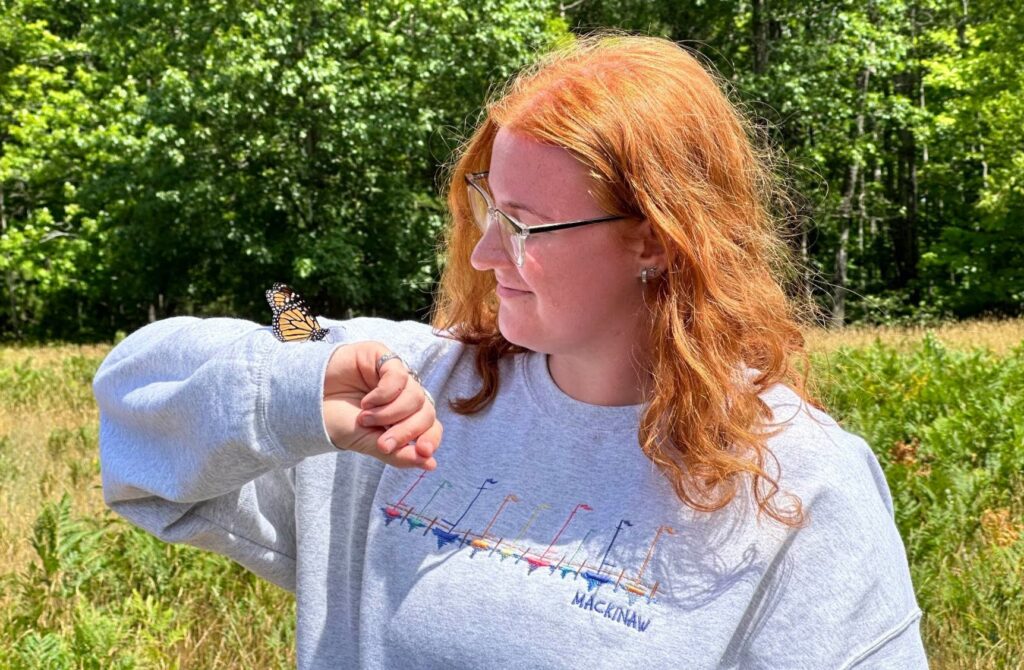
One of my classmates told me later she seemed to be a female monarch, judging from the pattern of her wings. I stared at her on my sleeve, moving my arm slowly to get different angles, for the remainder of the researcher’s talk for us. I can’t remember taking my eye off of her, other than to ensure that the steps I was taking wouldn’t shake her off of me, for the minutes-long walk back to our classroom. She was steadfast in her attachment to me, her tiny legs unmoving against my adjustments while walking, the wind, or her better judgement, you would think. For a moment I was worried she’d somehow gotten stuck, that this was terror for her.
I was embarassed at the attention she afforded me, classmates took photos (that I am grateful for, now) and I was met with awe and confusion as people slowly started to notice that I was standing rigid and quiet so as to not disturb my new little friend and respect the researcher by not distracting my classmates. They became distracted anyway. I think my peers may have attributed something to my character that day, something beautiful and perhaps gentle. I think I did, too. Now, looking back, I think I always deserved that—but I didn’t know that then.
I do not withhold the details of the trauma I faced before attending the BioStation to be mysterious or difficult, I just find them to be unimportant and change the tone of things too much. But to put you into my head; it had left me feeling betrayed, like a problem that had to be solved, something that was inherently wrong—I didn’t think I deserved much in the realm of goodness and love at all. I felt unlike myself because I could barely remember what had happened each day when I went to bed that night, kept misplacing little items because I couldn’t remember where I’d put them–or that I’d even touched them to begin with. I was often frustrated at that, felt like I was losing the one thing I had always had control over. I feared everything I could touch would find the wrongness within me and run away. This monarch didn’t.
How to Queer Ecology: The Queer Way of Thinking
I don’t think the world and its creatures just feel the love we pour into it, I think they give it back. I was so much larger than this monarch, everything I have learned of ecological science would suggest this monarch should have flown away. It should have felt threatened by my bigness and my movement. But we can only study the world as much as we have explained it in our human language—and then we hit a wall and realize that things are wilder than we allow them to be in our science, that they don’t only move through the world in patterned, logical ways; the world is wider than that, the world is more queer than that. I think that’s when I learned that wild things have the power to extend you some compassion when you may need it most.
Back then, I had taken a myriad of things to be reasons I was not good. That I was wrong and deserving of bad things. I had thought that there was no place for the likes of me, a nonbinary and queer person, in spaces that are natural and “pure”. All of those internalized homophobic and transphobic things that the human world tries to convince us of. It wasn’t really until this creature, this small natural being that drinks nectar and is evolutionarily specialized to be toxic to predators and hides in natural structures from unnatural threats and was believed to live only to protect itself from the prospect of dying, found safety in me, that I could say to myself that I had done nothing wrong.
It was the most safe I’d felt in forever. In my life I have most often felt safer in the wilderness than I have anywhere else. When I am among wild things I feel unbound from the definitions and immovable relationships that society seems to have agreed upon, that often don’t include me and those that I love. I cannot see the wilderness as separate from humans, as we’re demanded to as we further destroy it, because it has always been the place where I feel most human–most alive and most likely to stay alive. But the world is only within us as much as we are within it. Let yourself be within the world and it will love you. That’s what I really mean by “queer ecology”, that’s what it’s really taught me.
Myself and all my queer friends love this queer world and I know that it loves us too.
Brianna is a Cultural Organizer with Student Life Sustainability who recently graduated from UofM with a degree in Ecology, Evolution, and Biodiversity and a minor in Creative Writing.